


 русский
 Español
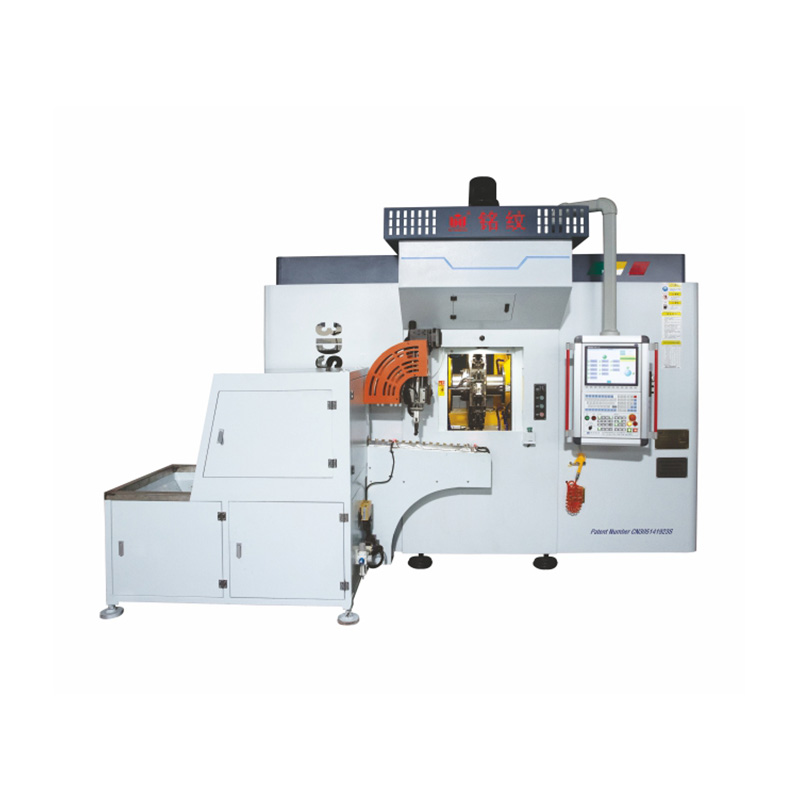
Rotary Transfer Machine Multi-Spindles for Multi-Process One-Time Clamping Solutions
A fundamental goal in precision machining is to complete as many operations as possible in a single workpiece setup. Rotary Transfer Machine Multi-Spindles are a direct embodiment of this "one-time clamping" philosophy. This article examines how these machines function as integrated multi-process solutions, transforming a raw material into a finished part in one continuous, automated cycle.
The Foundational Advantage of Single Setup Machining
Completing a component in one clamping offers distinct and connected benefits. The significance is the positive effect on geometric accuracy. When a part is moved between different machines for separate operations, tiny variations in alignment and clamping pressure can introduce errors. These errors accumulate, potentially affecting the relationship between features machined at different times. By securing the part once and subjecting it to all required processes without release, all machined features are directly referenced to the original setup. This inherently supports tighter tolerances on aspects like concentricity, perpendicularity, and positional relationships between holes and surfaces.
Beyond accuracy, this approach simplifies the production flow. It removes the need for intermediate storage, handling, and queueing between different machines. This compression of the process chain reduces the part's total production time, lowers work-in-progress inventory, and can decrease the required factory floor space. It also simplifies production planning and logistics, as the part essentially follows a single, contained process route.
Architecture of an Integrated Solution
A Rotary Transfer Machine with Multi-Spindles is purpose-built to execute this multi-process strategy. Its core is the rotary indexing table with multiple spindles. Surrounding this table are modular workstations. Each station is a self-contained unit that can be equipped to perform a specific task: one for drilling, another for turning, another for milling, and so on. The part visits each station in sequence as the table indexes.
The integration is comprehensive. It is not merely a collection of functions placed side-by-side; it is a synchronized system where the timing of each station's operation is coordinated with the index cycle. Furthermore, the solution often extends to include automated loading of raw material and unloading of finished parts, creating a closed-loop production cell. Ancillary processes, like in-cycle deburring or probing, can be incorporated as dedicated stations, making the output a truly finished component.
Implementing the One-Time Clamping Strategy
Applying this strategy begins with a review of the component drawing. Engineers assess whether all critical features can be accessed from the orientations allowed by the machine's spindle configuration and tool approaches. They then devise a machining sequence, distributing operations logically across the available workstations. Tooling design is important, as specialized combined tools are sometimes used to perform more than one operation at a single station, for efficiency.
The goal is to create a process where the part is never manually re-oriented or re-clamped after the initial load. Every operation, from the initial rough cut to the final inspection, is predetermined and executed automatically within the cycle of the Rotary Transfer Machine Multi-Spindles. This requires careful planning but results in a robust and repeatable production method.
The Rotary Transfer Machine Multi-Spindles offers a tangible realization of multi-process, one-time clamping manufacturing. By fixing a workpiece and subjecting it to a sequential yet continuous battery of operations via a rotary index system, it addresses core challenges of accuracy and logistical complexity. This technology provides a consolidated solution for part manufacturing, moving the workpiece from raw state to completion in a defined, automated sequence. For components suited to its methodology, it represents a coherent approach to organized and precise volume production.

- No.1-2,24th Street, Eastern New District, Wenling City.Zhejiang Province
-
+86-13906540425
+86-13566858277
+86-576-87168388
+86-13757649712 - +86-576-87168398
- [email protected]
[email protected]
 Privacy